
Concepts and components of payment
The payment system which a company establishes will determine employees’ behavior, which is why it is important for human resource management. This is because, in the words of Chiavenato (2000):
the salary people receive will determine their economic power – and establish and determine their buying power- their sociological power, - since it conditions their status and social prestige, and has an important psychological effect on workers’ sense of worth and self-esteem.
In addition, a worker’s payment is an important factor in determining his/her job satisfaction, and therefore, it plays a fundamental role in employee motivation.
However, from an organizational point of view, there is no doubt that how much is paid, and to whom, directly affects a company’s costs and competitiveness.
When establishing compensation policies in a company, certain organizational objectives should be set (Werther and Davis, 2008):
Nevertheless, it is necessary to take some things into account when establishing payment policies:
- Payment satisfaction exists in relation to the quantity received and what the person thinks he/she should receive. This can give rise to three types of perceptions: satisfaction, insufficient payment (when the employee believes that he/she should earn more for their work) and excessive payment (the person feels he/she earns too much).
- The feeling of satisfaction is influenced by making comparisons with the situations of others.
- People poorly perceive the payment of others. They tend to exaggerate it, or diminish others’ capabilities and skills in a way that makes them feel underpaid in comparison with other workers
Payment can be conceived from a broad viewpoint, such as the group of benefits an employee receives for doing his/her job. This includes not only financial compensation, but also job satisfaction, prestige, promotion possibilities, etc.
In the following diagram, we present a classification of different types of payment according to García- Tenorio and Sabater (2004):
When the time comes to design a payment system, the company should try to meet their strategic objectives and make sure that the system is adapted to the needs of every worker, allowing for some flexibility when negotiating benefits packages.
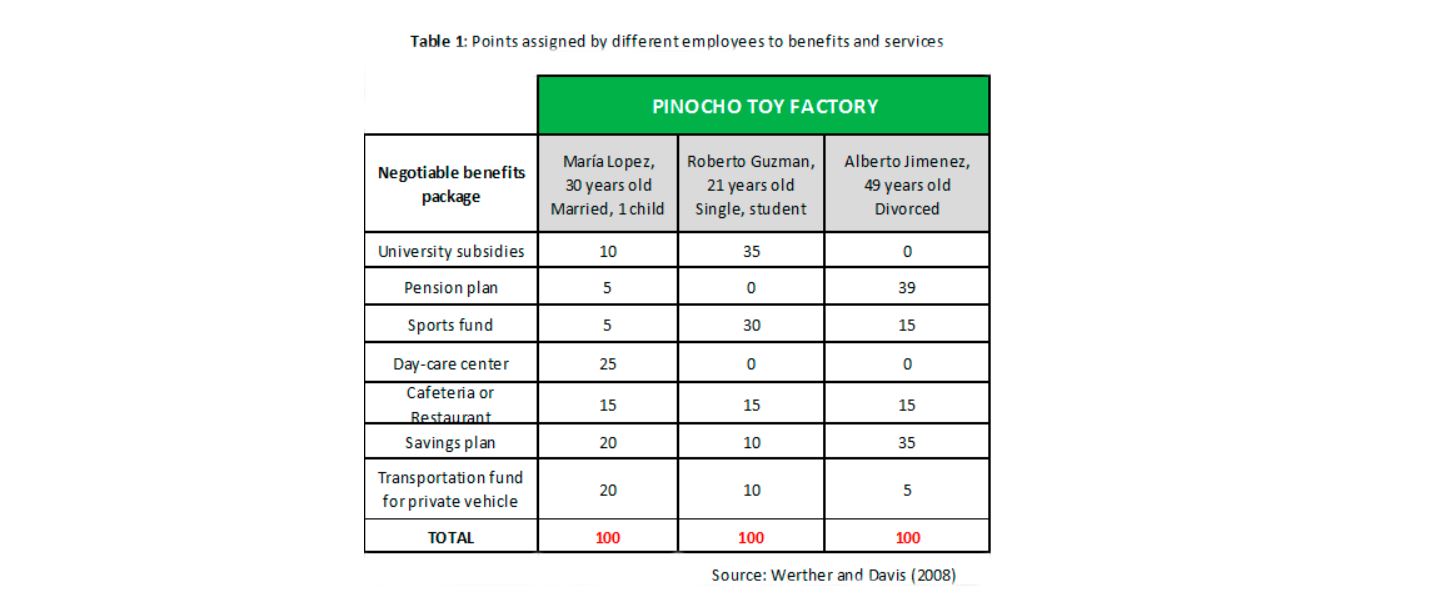
An example of how service/benefit needs may vary from one employee to another is provided by Werther and Davis (2008). In the table we can see how three employees allot 100 points to different services offered by the company, in relation to the importance they have in each case.
When establishing compensation systems, it’s necessary for the company to evaluate a series of strategic questions which will influence the system’s main characteristics. Thus, the company should assess:
Principle payment systems
PAYMENT BASED ON THE JOB
Payment systems based on the job are the most widely used by organizations. They consist of establishing salaries, differing according to positions (different positions, different salaries). Therefore, a key job with major repercussions on the company’s results will have a higher salary than a low level job in the organizational structure.
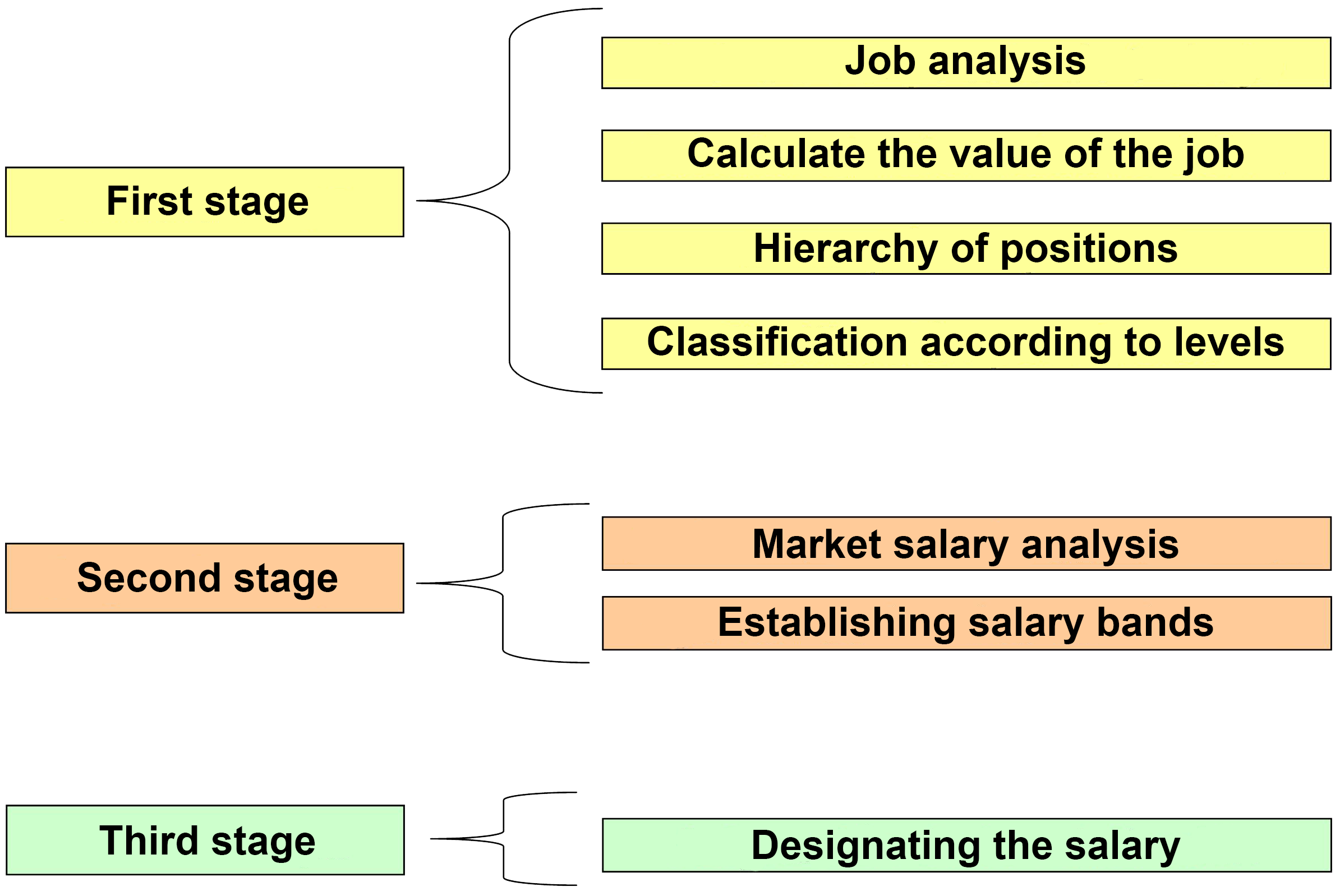
According to García-Tenorio and Sabater (2004), the stages in establishing salaries based on positions are those which appear below:
FIRST STAGE
Click on each tab
Different positions are analyzed and organized into hierarchic levels. As a starting point, job analyses are made for the positions in the organization. Once that is done, a calculation of the relative value of the job is made. There are different methods for doing this: ranking, grading and point systems. In this first stage, a committee made up of different members of the company, (supervisors, managers, Human Resource personnel and external consultants) normally collaborate.
In this method, which is one of the most imprecise, the assessment committee makes job ratings based on criteria such as responsibility, capacity, effort or working conditions. However, this rating is based on subjective evaluations, which could mean that some fundamental aspects of the job are excluded. The ranking system permits, nevertheless, that higher level jobs are better paid.
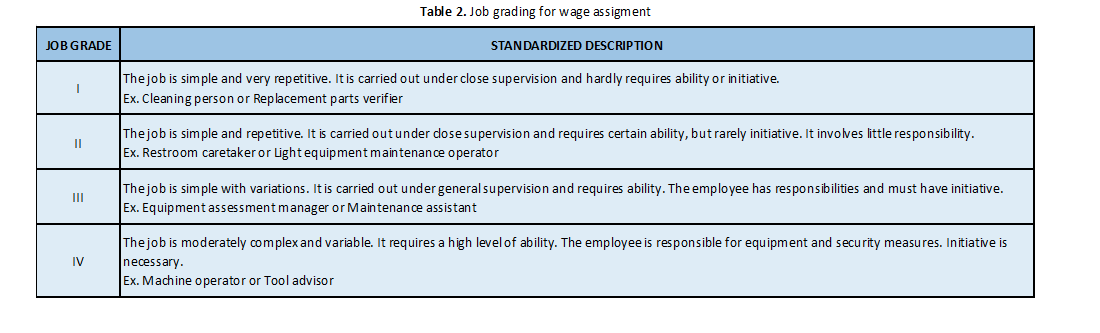
This system consists of assigning different grades to jobs according to certain characteristics. Wages will be subsequently fixed to each one of the grades.
An example of different grades is provided by Werther and Davis (2008) in the following table:
This system is the most widely used on an organizational level, although it is also more complex. In order to design an adequate point-giving system, the expert committee should follow these 6 steps.
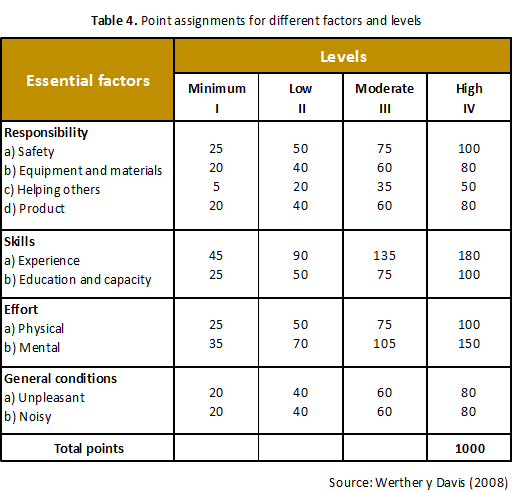
- Identify key factors. This means identifying common factors in the majority of the positions (ex. skills, effort, responsibility and working conditions). Some sub-factors (ex. responsibility for safety, equipment and materials, helping others, product quality, etc.) should also be identified.
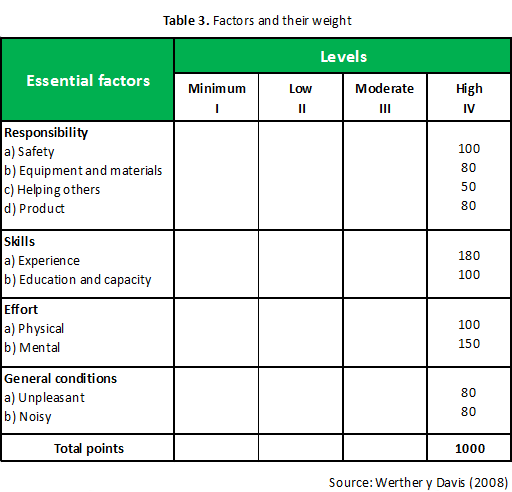
- Determine a level for these factors, since the importance of each factor could vary among different positions in the company. In this example, four levels have been established: minimum, low, moderate and high.
- Assign points to sub-factors. The committee assigns points to different sub-factors of the main framework, beginning with the most important, and in a subjective way.
- Assign points to different levels (once points have been assigned to each sub-factor at the highest level, lower level points can be assigned).
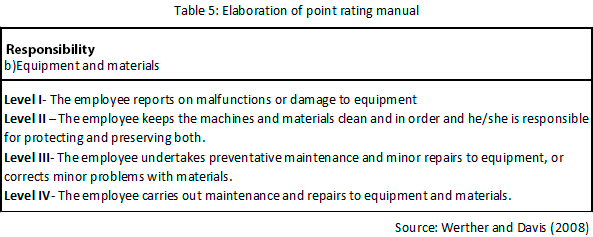
- Elaborate a point rating manual (fact sheets are designed indicating how different levels in the sub-factors will be assessed).
- The expert committee can calculate the value of each position.
Ex. The job of OPERATOR, which includes the responsibilities of carrying out preventive maintenance and correcting minor problems with materials or equipment, will be allotted 60 points in said sub-factor (level III of responsibility for equipment and materials).
Below we will offer an example of a job evaluation for an engineer, responsible for business in international public works.
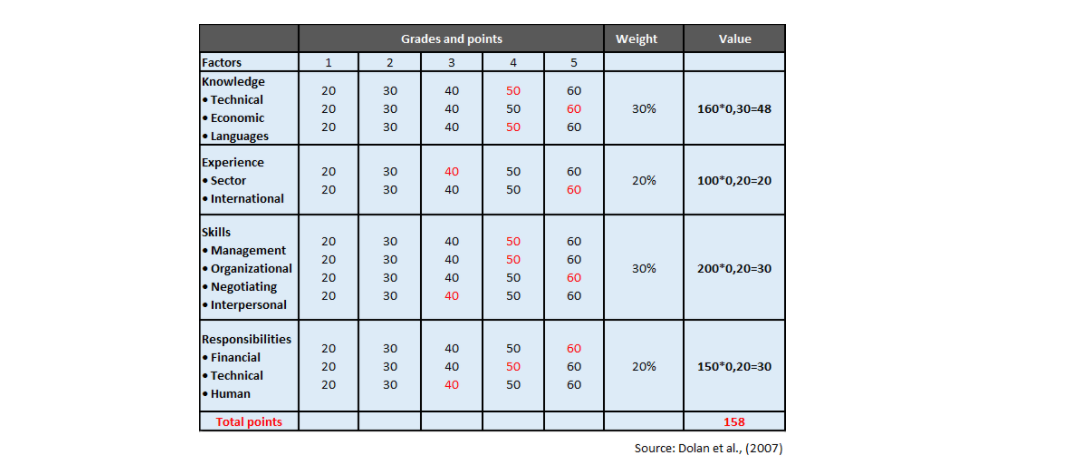
In the end, a job evaluation based on the points obtained is acquired, allowing the making of comparisons and establishment of pay levels

The first stage of establishing a payment system is where internal wage equity is sought. Equity is based on the principle that each job in the company should be compensated according to the place it occupies in the company’s structure.
SECOND STAGE
Click on each tab
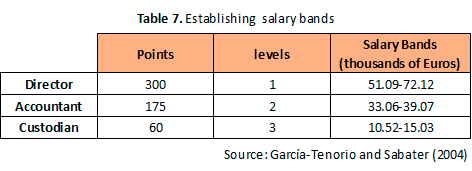
Organizations can use information obtained from official organizations, business associations, professional organizations and their own comparative studies. It is important to remember, when investigating the salaries of key positions in the market (managers or directors), the study should consider not only local, but also national and even international contexts.
The information obtained helps to establish salary bands.
The compensation policies of an organization can be oriented towards an average salary level for a key position or they can establish compensation above or below the market average.
Depending on the company’s salary position, it might or might not have external equity. In order to achieve this equity, workers should perceive that their salaries are similar to those of people doing the same or similar jobs in other companies. Positioning above or below external equity will have repercussions for the organization in relation to its capacity to attract and keep key employees (higher salaries than the competition) or the possibility of having a high turnover rate (lower salaries than the competition).
THIRD STAGE
PAYMENT BASED ON THE INDIVIDUAL
Payment systems based on the individual reward workers according to the skills and competences they possess. This means that the company doesn’t pay the employee for the position he/she occupies, but rather for the variety and level of the tasks he/she is able to carry out. This payment system has the aim of promoting continuous learning and thus allowing the organization to gain in flexibility and competitiveness.
There are three types of skills which can be compensated:
Payment and performance, incentive systems
There are many different types of incentives which have the objective of valuing and rewarding performance. We are going to classify them according to who receives them:
- Individual incentives
- Group incentives
- Organizational incentives

a) Individual incentives
This is the most commonly used type of incentive in organizations. The objective is to reward the employee in an individual way in order to encourage good performance. The three most widely used types of individual incentives are merit pay, bonuses and gratuities.
b) Groups
The company can give bonuses and gratuities to those members of the team whose performance they want to encourage and reward. In this case, it is essential that the bonuses and gratuities be allotted to groups where everyone’s cooperation is necessary in order to meet the objectives and where individual contributions by members of the group can’t be easily isolated.
c) Organization
The organization rewards employees based on the performance of the company as a whole. In this case, the policy consists of establishing an equal incentive for those employees who achieve determined global results. The most widely used system at this level is benefit sharing (allotting benefits in equal parts to all employees), but gain sharing (offered, for example, for increased productivity or profitability), is also frequently used. Companies also give incentives through capital stock sharing (company stocks are given or offered at a lower price to workers in the organization).
According to Gan (1996), the basic model for the establishment of a compensation system which ties performance to payment will be that which appears in the following graphics.
Salary Plans. Resistance, detection and neutralization of threats
Once a salary plan has been set, workers may demonstrate certain resistance to accepting what has been established by the Human Resource department. This resistance or disagreement with salary policies can provoke different types of problems inside the company (Gan, 1996):
The Human Resource department has to, as part of its duties, make sure that personnel policies are correctly implemented. Therefore, it should ascertain if salary policies are accepted by the workers in the organization and be alert to problems which arise on an organizational level. In order to do this, a series of key indicators can be analyzed, and in the case of threats to, or lack of acceptance of the salary plan, propose measures to neutralize these problems. The most important indicators to examine and ways of neutralizing them appear in the following table (Gan, 1996).
Summary
Compensation in a company is a fundamental element of human resources, since salary cost structures, job satisfaction and employee behavior depends on it. Total compensation includes not only financial rewards, but also everything that the job provides the worker, such as prestige, possibilities to grow, status, personal enrichment, etc. However, financial compensation is the aspect which has been most extensively treated academically.
Financial compensation is made up of direct payment, which means, that which the worker receives in the form of money, and indirect payment, or that which the worker receives in the form of services, benefits and time not worked.
Bibliography
- Chiavenato, I. (2000): Administración de recursos humanos, Ed. McGraw Hill, Colombia.
- Dolan, S., Valle, R., Jackson y Schuler, R. (2007): La gestión de recursos humanos, McGraw Hill, Madrid.
- Gan, F. (1996): Manual de programas. Desarrollo de recursos humanos. Ed. Apóstrofe, S.L., Barcelona.
- García-Tenorio, J. y Sabater, R. (2004): Fundamentos de dirección y gestión de recursos humanos, Thomson, Madrid.
- Werther, W. B y Davis, K. (2008): Administración de recursos humanos, 6ª edición, McGraw Hill, Méjico D.F.